


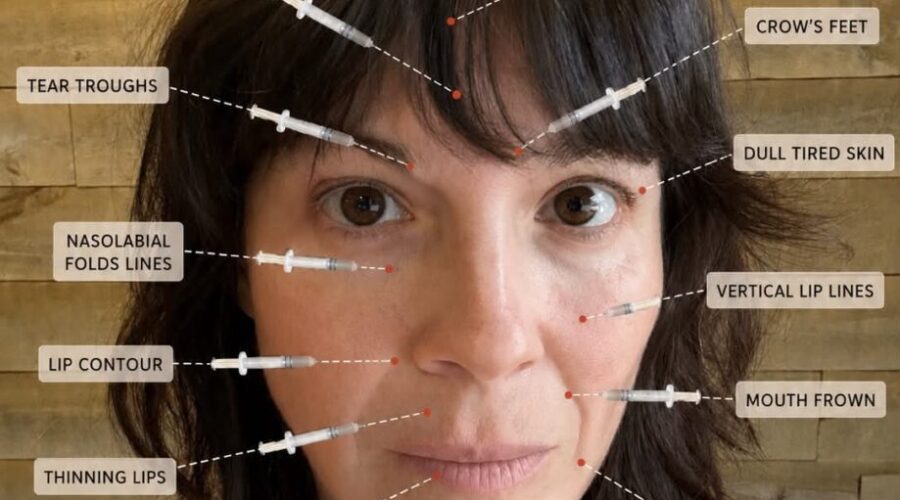
This morning I was looking at myself in the mirror, and scrutinzing every single part of my face that I felt needed to be changed:
- my thin lips, with fine lines all around them (“Smokers Lines” – even though I’ve never smoked!)
- The saggy skin on my upper eyelids – hooded eyes in my youth, droopy eyes as gravity takes it’s toll
- my large pores
- my marionette lines
- wait, are those jowls starting!?
- whyyyyyy does my neck look this way
- why are my eyebrows so uneven
- should I use Rogaine to fill my eyebrows?
- my forehead lines that are there even when my face is static
- my long philtrum
(Just to name a few; give me a mirror and 30 seconds and I could find so many more)
And then I stopped and thought about how many of those things I would be so self-conscious of, if it weren’t for social media and all of the ‘beauty influencers’ who have told me they’re ‘wrong’.
For example, I NEVER thought of my philtrum – like, had not given it a SINGLE THOUGHT in nearly 42 years – until I saw people saying to get a botox lip flip to make your philtrum shorter, as a shorter philtrum makes you look younger. Nobody wants a LONG philtrum (and guess what I have).
To be honest, I can’t tell if ANY of these things would be things that I noticed about myself if social media hadn’t told me to notice them. But now that I HAVE noticed them…they’re all I see.
A couple months ago, I shared that I was going to stop dying my hair; I was going to let my glitter come in. I’ve been loving the process so far, and I get really excited to see to see it taking over my head. But I don’t know how to take that same feeling of LIBERATION that I have with my hair and apply it to all the rest of me.
I’m not alone in this struggle:
A study with The Millennium Cohort found that ‘greater social media use’ was related to ‘poor body image’ and, in turn, higher rates of depression.
In another study of the relationship between social media addiction and body dissatisfaction, women in their undergraduate had more symptoms of social media addiction and were also more aware of appearance pressure.
Whether we use critical thinking when consuming media online or not, it still plays a huge role in telling us what is attractive in society. Beauty influencers, and celebrities on social media, set an ideal that is often unattainable without surgery or cosmetic procedures, but they TELL you you just need to buy xyz to look like them. These impossible ideals affect the way we perceive ourselves and, as a result, how we value ourselves.
I know this is nothing new. In the 90s and early aughts, it was a standard of thinness that told women with completely normal bodies they were fat. But that standard is still there, and NOW we’re adding ‘here’s all the other things you need to worry about too – and we will make sure this is ALL you get on your social feeds because that’s how algorithms work’.
It isn’t ALL bad, of course; I attribute influencer culture for transforming how women my age are navigating midlife. For years, perimenopause was a taboo subject, and so many women suffered in silence. Influencer culture shattered this stigma by creating online communities and providing highly visible validation to women like me.
However, “menopause capitalism” is also a real thing, and I can’t tell you how many creams, or supplements, or whatever I’ve been told I need to ‘feel better’.
I don’t know what the solution to this problem is, apart from getting off social media entirely – but that’s not realistic, as so many of us use it to connect with loved ones who live far away, or use it for work.
I also don’t know the answer to the question I keep asking myself, “Are these flaws mine, or were they marketed to me?”
All I DO know is that this is between my mirror and I, and I’m keeping my daughter out of it because she will come to a point in her life when she sees herself through an Algorithm and doesn’t need me to expedite the process.